 |
|
Home / Articles >
|
The Anatomy of a Nuclear Weapon
A nuclear explosion is an extremely rapid release of the energy contained within the nuclei of atoms. At the core of a nuclear explosion lies the process of fission (splitting) of atomic nuclei of certain unstable isotopes like uranium-235 or plutonium-239.
Under the right conditions a sustained chain reaction can occur. Such reactions in which the process itself produces what is needed to sustain it are called chain reactions in both chemistry and physics. Both reactions are due to the atom transitioning to a more stable lower energy state, with the excess binding energy that was required to maintain the previous arrangement released. In the case of chemical reactions there is a rearrangement of the electrons. In the case of a nuclear reactions, there is a rearrangement of the nucleus. A chemical explosion converts mass to energy in the amount of roughly one part in a billion. Nuclear fission converts about one part in a thousand, a million times more efficient than chemistry.
Uranium-235 is a naturally occurring fissile isotope of uranium, making up about 0.72% of uranium-238. The uranium-235 must be separated from U-238 through methods like gaseous diffusion or cascades of gas centrifuges. Plutonium-239 is synthesized by irradiating uranium-238 with neutrons in a nuclear reactor. In this reaction, uranium-238 captures a neutron and transforms into uranium-239. In turn, the uranium-239 converts to neptunium-239 by losing an electron. Then, in the same way, the neptunium-239 transforms into plutonium-239. Uranium-238 is fissionable, but requires extremely energetic neutrons (14 MeV) and is not self sustaining. Uranium-235 and plutonium-239 are fissile, meaning they are capable of a self sustaining a nuclear chain reaction when capturing low energy thermal neutrons.
The processes to produce either of these materials are complex and expensive, requiring nation state level industrial facilities.
Pure fission weapons (A-bomb, atom bomb) have been superseded by thermonuclear designs (H-bomb, hydrogen bomb) powered by the fusing together of the atomic nuclei of hydrogen rather than splitting them. These weapons can have yields tens of orders of magnitude greater, but still require a fission device to create the vast temperatures and pressures required for fusion to occur. Most modern nuclear arsenals will utlilise only thermonuclear designs.
Fission
An atom consists of a nucleus which contains 99.94% of the mass of the atom. Surrounded by an electromagnetically bound swarm of negatively charged electrons. The nucleus is made of two types of particles: protons, which carry a positive electric charge, and neutrons, which carry no charge at all, they are neutral. They both have roughly the same mass, about 2,000 times heavier than an electron, and are both packed tightly in the nucleus. The electromagnetic force repelling the positively charged protons is trying to blow the nucleus apart. To put this into perspective, the force repulsing the two protons is 230 Newtons. This is equivalent to the force required to support a 23 kg object at the macroscopic level, acting on a subatomic particle only one femtometer (quadrillionth of a meter) wide.
However, at distances of less than a single proton, another one of the other four fundamental forces of nature takes effect, the strong nuclear force. The strong nuclear force is 100 times more powerful than the electromagnetic force, but only functions at extremely small distances.
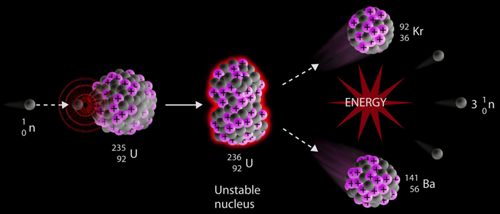
A uranium-235 nucleus contains 92 protons and 143 neutrons, being so large it is teetering on the very edge of stability. Neutrons, having no charge are able to enter an atom without being repulsed by the electromagnetic force. If the nucleus captures and absorbs a stray neutron it becomes uranium-236, the delicate balance between the two opposing forces is broken, the geometry of the nucleus distorts then splits. Two new atoms are created typically barium-141 and krypton-92 flying apart at roughly 3% of the speed of light. Along with the two fragments atoms, two or three free neutrons and high energy photons are released.
Each of the released neutrons can trigger fission in another uranium-235 atom in an exponentially increasing nuclear chain reaction. The number of fissions doubles with every generation and a generation takes about 10 nanoseconds, 10 billionths of a second. After about 80 generations, which takes roughly a microsecond (millionth of a second), you have on the order of 10 to the 24th (million billion) divisions happening virtually simultaneously.
|
The total mass of the fragments produced is less than the mass of the original nucleus. The lost mass has been converted into energy as per the energy mass equivalence expressed in Albert Einstein's famous equation E=mc². It is precisely this missing mass energy that is released during induced nuclear fission. Since within a very short time a very large number of nuclei split per unit of time, an enormous amount of energy is released per unit of time in what we call a nuclear explosion. It is important to understand that rapidity of the energy release is a significant factor in the destructive force of a nuclear explosion.
However, energy is not some independent substance. It is merely a characteristic of physical objects, a measure of their ability to perform work. Therefore, whenever we speak about the release of energy, we must understand which objects receive this energy and in what form. In the case of a nuclear explosion, the energy is released in three main forms -
Firstly, it appears as kinetic energy of the neutrons emitted during the fission process. This accounts for about 3-4% of the total energy of the nuclear explosion. Part of the energy transforms into excitation energy of atomic nuclei, whose nucleons move to higher energy levels. Ultimately this is also kinetic energy, but of nucleons that remain bound within nuclei. After a short time this energy is emitted as photons with energies of about four million electron volts (4 MeV). This is hard gamma radiation which makes up about 5-6% of all the energy released in the explosion. Third, a significant part of the energy goes into the kinetic energy of the fragment nuclei.
Temperature is nothing other than the kinetic energy of atoms or molecules of matter. Thus in effect this portion of energy is spent on heating the material of the bomb itself and the surrounding air. About 90% of the total released energy is used for this heating process. This is hot enough to emit black-body radiation in the X-ray spectrum. These X-rays are absorbed by the surrounding air heating it to tens of millions of degrees Celcius, producing the fireball and blast of a nuclear explosion.
Critical Mass
Critical mass is in essence the amount of fissile material required to sustain a self-sustaining nuclear chain reaction. The critical mass of a fissionable material depends upon its nuclear properties (specifically, its nuclear fission cross-section), density, shape, enrichment, purity and temperature. A critical mass is a mass of fissile material that self-sustains a fission chain reaction. A supercritical mass is a mass that, once fission has started, will proceed at an increasing rate.
For uranium-235 a critical mass for a sphere at normal density is about 47 kg, for plutonium-239 the same sphere needs to be about 10 kg. A spherical geometry provides the best ratio of internal volume to external surface area, limiting the escape of neutrons. This critical mass must now be forced into a supercritical state, then externally bombarded with neutrons to initiate a nuclear explosion. Injecting neutrons allows for precise control of the initiation point when the fissile material is at an optimal state of supercriticality increasing the yield.
Explosive implosion
|
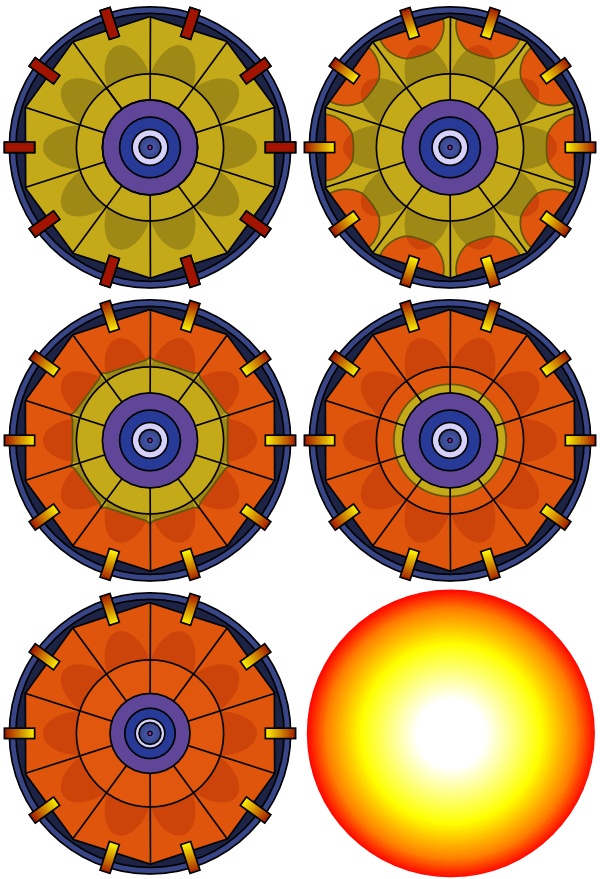
The usual method of assembling this supercritical mass is to use a system of chemical explosive lenses to compress a subcritical ball (pit) of plutonium into a supercritical fluid mass. The detonation timing of the lenes needs to be extemely precise to ensure a perfectly simetrical implosive wave. Some weapon systems use other implosion mechanics or non-spherical implosion geometries.
To achieve the maximum number of fission generations before the weapon core disintegrates, a number of methods can be employed in the weapon design. Greater efficiency means a larger yield for the same amount fissile material, or the same yield for less extremely expensive material and a smaller weapon. Even modern optimised fission weapons will only consume 20-30% of the fissile material before disassembly of the core stops any further fission events.
Assembly Rate and Density - Faster assembly of the supercritical mass minimizes premature detonation and maximises efficiency. Higher pit density means a shorter mean free path for the neutrons, and a higher multiplication rate in the chain reaction.
Tamper/Reflector - A layer of dense material typically depleted uranium-238 or tungsten surrounds the critical mass, providing inertia to hold the core together longer reflecting neutrons back into the core. If uranium-238 is used it will undergo fast-fission caused by the high energy neutrons from the core adding to the yield.
Pusher - An intermediate density layer between the explosive and the tamper helps suppress the Taylor Wave phenomenon, which reduces the efficacy of the implosion shockwave.
Levitated Core - Instead of a contiguous tamper-core, the core is suspended within a hollow space in the tamper with a gap between them. The collision between the tamper and core increases compression efficiency due to the acceleration of the shockwave across the gap reducing Rayleigh-Taylor instability.
Boosting - Injecting deuterium/tritium gas into the pit allows for higher efficiencies by creating a rapid neutron surge.
Thermal Radiation and Blast
The enormous release of radiation is absorbed by the surrounding air, heating it to tens of millions of degrees, a point where it releases radiation itself. This process forms a fireball and decreases the energy of the radiation: from gamma rays to X-rays to ultraviolet, visible light, infrared, and radio waves. Continuing to expand at many times the speed of sound, the fireball forms two distinct regions: the center remains extremely hot while the temperature of the outer part falls as it pushes the surrounding air away. The heat radiated by the outer layer produces a short initial flash of light. The fireball brightness decreases and breakaway occurs: a blast wave separates from the fireball's surface. The blast wave is an expanding sphere of highly compressed and fast moving air. Initially the blast wave travels at ten times the speed of sound. The wave pushes the air away before it so that a partial vacuum is created behind it.
Now that the fireball is no longer pushing the blast wave before it, the outer layer is reheated by the interior to reach a uniform temperature. As the fireball expands and rewarms, a second longer flash begins. The characteristic double flash caused by the shock wave–fireball interaction, is a unique signature feature of nuclear explosions. The fireball now begins to release the vast amount of thermal energy it contains, burning skin, igniting flammable materials and creating fires. To anyone observing the fireball, it would appear hundreds of times brighter than the sun, causing retinal burns and permanent blindness tens of kilometers away.
The shock wave expands outward from the explosion's center at several hundred kilometers per hour, shattering buildings and filling the air with flying debris. As the distance from the explosion increases, the strength of the blast wave drops rapidly. The negative pressure in the wake of the blast, and the updraft created by the rising fireball creates powerful inward travelling winds. This air drawn in from the surroundings feeds the fires created by the thermal pulse creating an intense firestorm.
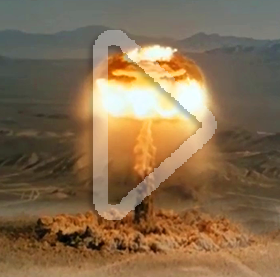
This video illustrates the initial shock wave reflecting off the ground and interacting with the fireball, and both the positive and negative phases of the blast wave as it propagates outwards.
The distribution of destructive energy released can be roughly broken down as follows - blast 60%, thermal radiation 35% and ionizing radiation about 5% for explosions with yields of less than 100 kilotons. Larger yield detonations into the megaton range produce a higher percentage of thermal radiation, but blast remains the dominant destructive force.
Wilson Cloud -
When a nuclear weapon is detonated in sufficiently humid air, the high pressure phase of the shockwave is trailed by a low pressure phase. The drop in temperature in low pressure air causes moisture to condense, forming a transient condensation cloud, also known as a Wilson cloud. Depending on factors such as weapon yield, humidity, air density and altitude, the cloud can take the form of partial or complete expanding shells, multiple rings, or lenticular disks above the fireball.
Fallout
The radioactive fallout from a nuclear explosion consists of three main components -
First, there is the portion of the bomb's radioactive material that fails to undergo fission during the explosion. Even in the most efficient modern nuclear weapons, only about one third of the fissile material actually splits during detonation. The rest evaporates and then disperses into the surrounding area as fine dust. Modern bombs generally use plutonium-239, an alpha emitter with a half-life of 24,000 years, which ensures long-term radioactive contamination of the affected area.
Second, there are the fission products, the fragments into which atomic nuclei split during the chain reaction. These fragments themselves are highly radioactive. As a result of the explosion and through their subsequent dispersal over the surrounding terrain, isotopes are formed with half lives ranging from several hours to several hundred years.
Finally, to this radioactive mixture are added isotopes formed by the irradiation of the soil and air around the explosion center due to the intense neutron flux produced during the chain reaction. To understand how all this radioactive material spreads across the terrain, we need to look at the final stages of the explosion after the shock wave has detached and the fireball begins to fade.
The air heated by the explosion's energy around the center of detonation begins to rise upward due to convection, carrying with it evaporated particles of the bomb and radioactive materials lifted from the Earth's surface. The convective air currents raise this mixture into the upper layers of the atmosphere where the air pressure is lower. As it ascends, the air expands and cools, forming the characteristic cap of the mushroom cloud.
Meanwhile, in the region from which the air has risen, an area of low pressure is created. Air from the surrounding regions rushes in to fill it, dragging along additional dust and debris, forming the stem of the mushroom cloud. This radioactive mixture of gases and fine dust lifted high into the atmosphere is then caught by the wind and carried away. When the rising convective flow weakens and the particles lose their upward momentum, the heavier dust begins to fall back to the ground, a process known as radioactive fallout.
This video illistrates the powerful convective forces that draw material from the ground into the rising fireball, as well as the effects of the thermal pulse.
Fallout typically begins about 30 to 40 minutes after the explosion. A significant portion of the radioactive particles will settle around the explosion's epicenter. The rest will be carried away by the wind, forming a long radioactive trace downwind. Nuclear weapons are usually detonated at altitude to maximise their destructive effects. However they may be used at ground level against a hardened target. A nuclear detonation at or below ground level will significantly increase the quantity of nuclear fallout.
There are some positive mitigating factors t consider. First, these radiation levels are observed only during the initial period after the explosion, and then begin to fall rapidly following what is known as the 7:10 rule. The intensity of radioactivity decreases tenfold for every time interval that is seven times longer than the previous one. In other words, seven hours after the explosion, the radiation level will be ten times lower than it was one hour after the explosion. After forty-nine hours or about two days, it will be 100 times lower and so on.
Shelters of almost any kind provide substantial protection from fallout. In an ordinary apartment, the radiation level will be about five times lower than outdoors. In the basement of a single story house, levels will be 20 to 30 times lower. In the basement of a multi-story building, 100 to 200 times lower.
A weapon could be specifically designed to maximize contamination. Natural cobalt consists primarily of the isotope cobalt-59. Under the intense neutron flux of a nuclear explosion, cobalt-59 captures neutrons and transforms into cobalt-60, a highly dangerous radioactive isotope with a half-life of about 5.2 years. This half-life is short enough for the isotope to decay actively, becoming a powerful source of radiation, but long enough that it cannot simply be waited out in a shelter. By comparison, the typical fallout produced by an ordinary nuclear explosion decreases its activity tenfold within about seven hours, whereas cobalt-60 would require about seventeen years to decrease its radioactivity by the same factor. Thus rendering an area hopelessly contaminated for many years.
The prompt radiation from a nuclear explosion accounts for a relatively small proportion of the overall energy release and has a fairly short range. Any object or living thing close enough to be affected by it would be destroyed by the heat and blast. However some interesting effects of the radiation can be exploited for further destructive potential.
Neutron Radiation
The streams of high energy neutrons emerging from the the explosion pose a significant threat to living organisms, breaking molecular bonds and damaging cells. A notable characteristic of neutron radiation is its ability to be captured by atomic nuclei, transforming them into radioactive isotopes of the same elements, a process known as neutron activation. For instance, sodium-23, found within human tissues, can capture a neutron and become a radioactive isotope of sodium. This means that after being subjected to a strong flux of neutrons, bodily tissues and other materials can themselves become radioactive, a situation referred to as secondary radiation.
For example, neutron activation can occur in steel when neutron bombardment transforms stable alloy elements (Iron, Cromium, Nickel, Cobalt) into radioactive isotopes through transmutation, making the material a source of gamma radiation. Key activated radionuclides include iron-58, iron-59, chromium-51, cobalt-60 and manganese-54. Tantalum-182 can also produce severe radioactivity.
Anyone who happens to be close to metal objects that have been exposed to neutron radiation could suffer severe injuries. For this reason, a nuclear bomb's neutron radiation is regarded as a type of selectively damaging factor. It has comparatively minimal influence on inanimate objects and primarily affects living things near the explosion core.
This property gave rise to the concept of the enhanced radiation weapon (ERW), also known as the neutron bomb, a weapon specifically designed to optimize the release of neutron radiation. The idea is to eliminate enemy personnel while leaving infrastructure only lightly damaged. Neutron bombs are a type of thermonuclear weapon rather than purely nuclear. In essence, the elements of the weapon designed to reflect neutrons back into the core to increase the efficiency of the reaction, are redesigned to allow their release into the environment. The range of these neutrons is relatively short, but they are highly penetrating.
ERWs were designed by the U.S. in the 1970s as a tactical, low-yield nuclear weapon to counter the Soviet Union's superior armored forces in Europe. They were intended to incapacitate tank crews with radiation while minimizing collateral damage. America developed and operationally deployed the W66 ERW warhead in an anti-ballistic missile role with the Nike-X weapon system in 1975. In this role, the burst of neutrons would cause damage to incoming ICBM warheads damaging or disabling them.
Nuclear Electromagnetic Pulse (NEMP)
High energy gamma quanta are released by fragmented nuclei as they transition from excited to ground states. These photons also cannot travel very far. The overwhelming majority are scattered and absorbed by ordinary air within just a few hundred meters. However, before being absorbed, they have time to cause many interesting effects. In particular, they generate an electromagnetic pulse capable of disabling electrical and electronic systems.
The warbling audio distortion just after the initial flash is caused by the effects of EMP on the recording equipment during test Annie dpart of Operation Upshot-Knothole in 1953.
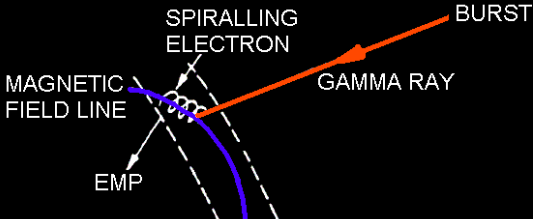
When high energy gamma quanta collide with the atoms of matter, for example, with nitrogen and oxygen in the air, these atoms are ionized (stripped of electrons). This is known as the Compton effect and the resulting current is called the 'Compton current'. These electrons then travel in the same direction as the original gamma quanta, moving at speeds close to that of light. These electrons, like all rapidly moving charged particles, are affected by the Earth's magnetic field. The force acting on a charged particle in a magnetic field is described by the Lorentz formula. This force is always perpendicular to the direction of motion, and if a force is perpendicular to velocity, the particle motion becomes circular or spiral. In this case, the electrons appear to spiral around the Earth's magnetic field lines, while continuing to move forward along them. Spiral motion is a special case of accelerated motion in the sense that during such motion the magnitude of the velocity vector remains constant but its direction changes.
Any charged particle moving with acceleration emits electromagnetic radiation. This is exactly what happens to the electrons knocked out of atoms by the gamma quanta originating from the explosion's core. Because of the enormous number of these electrons and their high speed, the resulting radiation is quite powerful. This radiation is what we call an electromagnetic pulse.
Electromagnetic radiation is nothing more than a traveling disturbance of electric and magnetic fields. When such a disturbance passes through conductors and semiconductors, it induces large chaotic parasitic currents within them. These currents destructively affect electrical and electronic systems, burning out electronic components.
The strength of an EMP's effects on a given device depends greatly on the size of that device. More precisely, it depends on the length of its internal electrical circuits within which parasitic currents will be induced. The strongest currents will arise in circuits whose lengths correspond to the wavelengths of the EMP which are on the order of tens or hundreds of meters. Therefore, many modern gadgets such as mobile phones and compact electronics will most likely survive. They are simply too small for electromagnetic fields to induce sufficiently strong currents within them. The systems most affected by an EMP will be electrical power networks. Within them, truly enormous voltages can be generated. The EMP will also be extremely destructive to communication systems, especially television, radio and mobile communication antennas since these structures are literally designed to respond efficiently to electromagnetic radiation.
The effectiveness of an electromagnetic pulse increases dramatically with the altitude at which the bomb is detonated. In the denser layers of the atmosphere, the electrons knocked out of atoms cannot travel very far, at best, only a few tens of meters before colliding with another atom and losing their kinetic energy. Consequently, they emit radiation for only a short time and radiate relatively little energy.
However, if the bomb is detonated in the upper atmosphere or orbit, the situation becomes entirely different. High energy electrons can travel for tens of kilometers emitting electromagnetic radiation all along their path perpendicular to the Earth's geomagnetic lines. Artificial radiation belts generated along the magnetic field lines can persist for a significant time disrupting radio communication and damaging space hardware.
While a surface or low altitude nuclear explosion produces an electromagnetic pulse with a range of only a few tens of kilometers, a high altitude explosion can affect an area thousands of kilometers across. The Starfish Prime test conducted by the United States in 1962 during Operation Fishbowl saw a nuclear weapon detonated in space 399 km above the Pacific Ocean which damaged electrical systems in Hawaii 1,445 km away. After the detonation, bright auroras were observed in the detonation area as well as in the southern conjugate region on the other side of the equator.
Starfish Prime caused both a direct EMP effect in the immediate area and a secondary 'conjugate' effect. In the context of a NEMP, the magnetic conjugate (or conjugate point) refers to the location in the opposite hemisphere where the Earth's magnetic field lines originating from the detonation site, return to the atmosphere.
In military terminology, a nuclear warhead detonated tens to hundreds of miles above the Earth's surface is known as a high-altitude electromagnetic pulse (HEMP) device. Effects of a HEMP device depend on factors including the altitude of the detonation, energy yield, gamma ray output, and interactions with the Earth's magnetic field at the location of the detonation. Nuclear EMP depends on the prompt gamma-ray output. Hence, small yield pure fission weapons with thin cases can be more efficient at creating EMP than megaton range thermonuclear weapons because the first stage can pre-ionize the air which becomes conductive rapidly shorting out the Compton currents generated by secondary fusion stage.
A nuclear EMP consists of three separate phase components. E1 is the first, fastest and most powerful phase of a high-altitude EMP, and is the phase weaponized as described above. E2 is an 'intermediate time' pulse, generated by scattered gamma rays and inelastic gammas produced by neutrons. E2 lasts from about one microsecond to one second after the explosion. The final phase E3 is much slower lasting tens to hundreds of seconds, caused by the nuclear detonation's temporary distortion of the Earth's magnetic field.
From a military perspective a weapon deployed to create a large widespread EMP could be used before a nuclear strike to disable infrastructure and information systems in a target country. Purportedly China and Russia have both developed weapons known as Super-EMP or Enhanced-EMP designed to maximise EMP pulse effects.
Article detailing the design, physics, delivery and effects of thermonuclear weapons.
|
|
|
|
|